Tava Health
A design exercise for the moment people quietly stop going to therapy: a post-session check-in that turns a silent exit into a conversation.
Most people who leave therapy on Tava don’t switch or complain. One or two sessions in, they just stop, and the product never hears why.
Solo, start to finish: research board, eleven directions, flows, UI, and motion. A design exercise, not shipped.
A post-session check-in that says the unsaid thing for you, plus a switch path that doesn’t start over. A prototype with a replayable motion study for every transition.
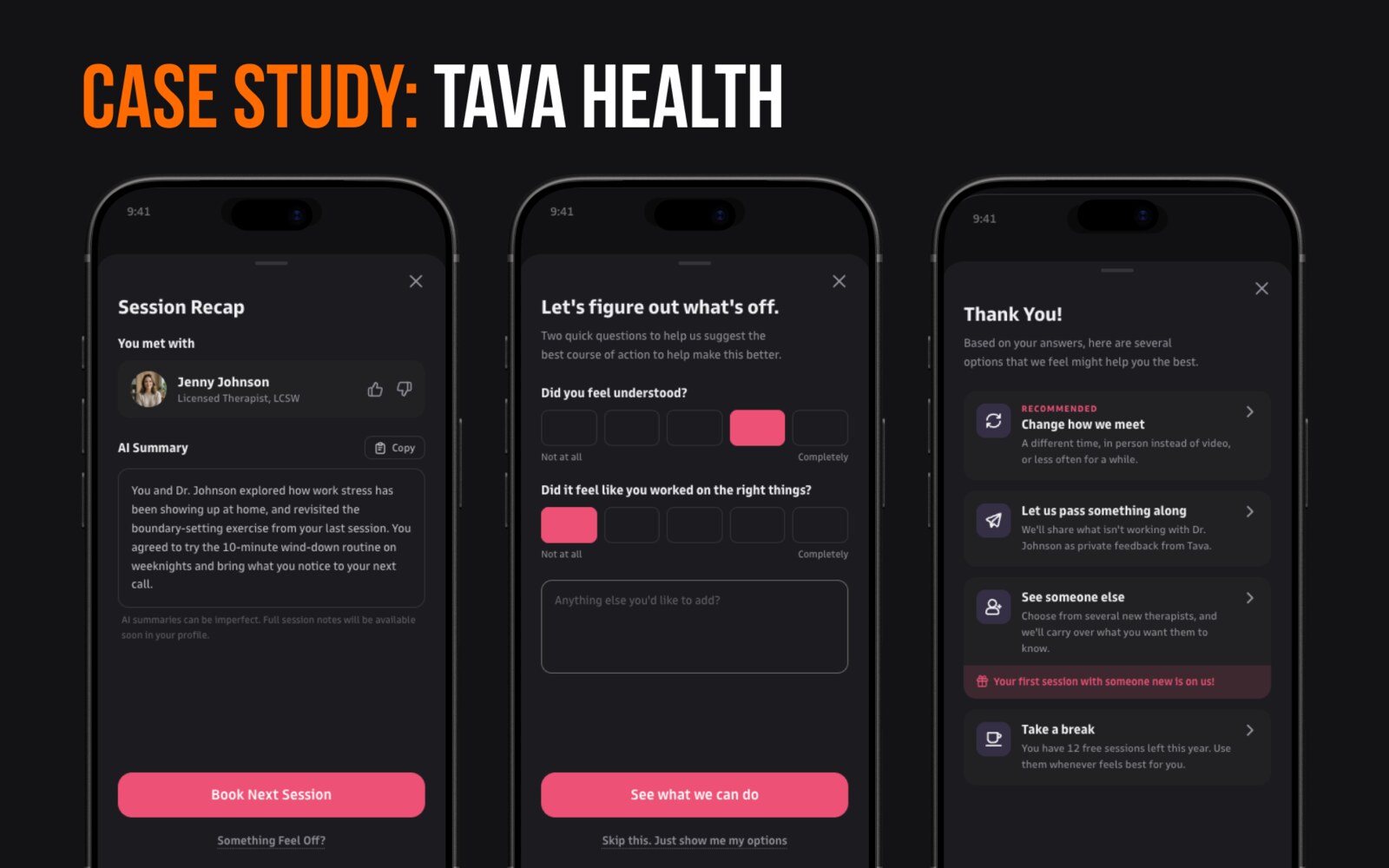
They just stop.
Tava lets you switch therapists quickly, and it does that part well. The problem is the people who never get that far: one or two sessions in, no rebooking, then silence. They don’t complain and they don’t switch. They just stop.
This began as a design exercise. I took it well past what it asked for, because the problem turned out to be more interesting than the brief: a post-session check-in that turns a quiet exit into a conversation.
- Research synthesis and the Whimsical research board
- Eleven intervention directions, narrowed to two, then one
- Flows, UI, and motion, built as a working prototype
- A design exercise: no access to Tava’s data, users, or team
- [Time box, and what the original brief asked for]
- [Where the research came from: who you talked to, how many]
The two ways people leave.
Two failure modes, and only one of them is visible.
The first is switching. It works, but every switch costs a first session. You restart your history with someone new, and the intake burns the hour you came for. That came up constantly in research as the biggest complaint about changing providers.
The second is the one I wanted to solve: people who just ghost. They’re the majority, and the product never hears from them. The question isn’t “why did they leave?” It’s why didn’t they rebook?
Eleven directions, then two.
I started in Whimsical with sketches and wireframes: about eleven directions for where an intervention could live. I compared all of them against the same four questions: when do you ask, what do you ask for, how is it framed, and who starts it.
Two survived. A concierge chat, where a person or an AI sits between you and the problem and surfaces prebuilt cards: here’s a fix, here are people you could try, here are open times. And a post-session check-in, which is simpler and lands while the feeling is still fresh.
I flowcharted both and compared them side by side. The check-in ran bigger as a flow, and it’s the one I picked.
The part I’m proud of.
Most of the time, leaving isn’t about the therapist being wrong. It’s about one thing that never got said.
So the check-in offers to say it for you. “What would you like them to know?” A few starter prompts, or write your own. Then, before anything sends: “Here’s exactly what we’ll send.” You see the message, you can edit it, you can back out.
It isn’t anonymous, on purpose. If a provider has one client, anonymity is a promise you can’t keep, so don’t make it. What Tava can offer instead is mediation: it comes from Tava, on your behalf, and there’s a paper trail.
The three lines under the message are doing the real work: they’ll get it before Friday, she’ll know it’s from you, you don’t have to bring it up. Every one answers a reason somebody would close the screen instead of sending.
And if you do want someone new.
The switch path attacks the thing that makes switching expensive: starting over. You pick from a short list of providers, then choose what goes with you (past notes, AI summaries, assessments). Your next therapist starts already knowing something about you, so session one isn’t spent rehashing. Then date, time, summary, and it’s on your calendar.
Booking is where good intentions go to die, so it stays inside the same sheet: month, day, time, confirm. No hand-off to a separate scheduler, no second app, no losing the thread you just worked up the nerve to pull.
A check-in, not a concierge chat
- Options
- A concierge chat, where a person or an AI surfaces fixes, providers, and open times; or a post-session check-in.
- Why
- The check-in is simpler and lands while the feeling is still fresh. I flowcharted both side by side before choosing.
- Trade-off
- The check-in ran bigger as a flow. [Draft: it also gives up the chat’s flexibility to handle anything.]
Not anonymous, on purpose
- Options
- Send feedback anonymously; or send it from Tava, on the client’s behalf, with a paper trail.
- Why
- If a provider has one client, anonymity is a promise you can’t keep, so don’t make it. Mediation is a promise Tava can keep.
- Trade-off
- [Draft: some people won’t send anything with their name on it.] The three lines under the message each answer a reason somebody would close the screen instead of sending.
Show exactly what sends
- Options
- Send from the prompt choice directly; or show the full message first, editable, with a way back out.
- Why
- “Here’s exactly what we’ll send.” You see the message, you can edit it, you can back out.
- Trade-off
- [Draft: one more screen at the moment someone is most likely to quit.]
Switching carries your history
- Options
- A fresh start with each new provider; or choose what comes with you: past notes, AI summaries, assessments.
- Why
- Every switch costs a first session spent rehashing. That came up constantly in research as the biggest complaint about changing providers.
- Trade-off
- [Draft: sharing records is a consent decision, so the client picks each item instead of everything moving by default.]
What I’d measure.
- Rebooking after a check-in. Do people who get the check-in book again more often than those who don’t?
- Messages actually sent. Of the people who open “what would you like them to know,” how many send it?
- Switches that keep history. How often people bring notes along, and whether second first-sessions get shorter.
- Silent exits. The share of clients who stop after one or two sessions with no signal at all. The number this whole flow exists to shrink.
What I’d do differently
[One honest answer: e.g. a direction you cut too early, or what you’d test first with real Tava clients.]
Motion, because it’s the whole question.
Calm, functional motion, no celebration. Nothing cheers when you tell your therapist something isn’t working. Whether a flow like this feels gentle or clinical can’t be answered in a static frame, so every transition is a replayable study in the prototype above.